
Top image: Petr Štefek, CC BY-SA 3.0 cz, via Wikimedia Commons
Artificial intelligence (AI) is talked about in connection with almost everything, and the railway is no exception. Behind the noise there are concrete cases: systems already in service, others being tested on the line and others that, for now, exist only in simulation. Telling them apart is the first step to understanding what the technology can really do.
In this article we look at four areas: traffic management, rolling stock inspection, obstacle detection and track maintenance. For each, we describe the problem, how the solution works, the published results and what is not yet known. By "AI" we mean programs that learn from data (images, sensors, traffic records) to recognise patterns and suggest decisions.
Which train goes first?
On a dense suburban network, a delay rarely stays on its own. If one train arrives late at a single-track section or at the entrance to a station, another has to wait for it, and that delay passes on to the next. Traffic controllers have to decide in seconds which train goes first, and each choice affects the whole network for the next hour.
Deutsche Bahn (DB) developed an in-house tool to help with that decision. The system analyses traffic in real time and flags conflicts before they happen. When, for example, a delayed train and another reach a single-track section at almost the same time, it works out in a fraction of a second the order that does least harm to punctuality, taking into account every train in the network and what will happen next. The controller can also simulate the effect of the recommendation before accepting it. The decision remains theirs.
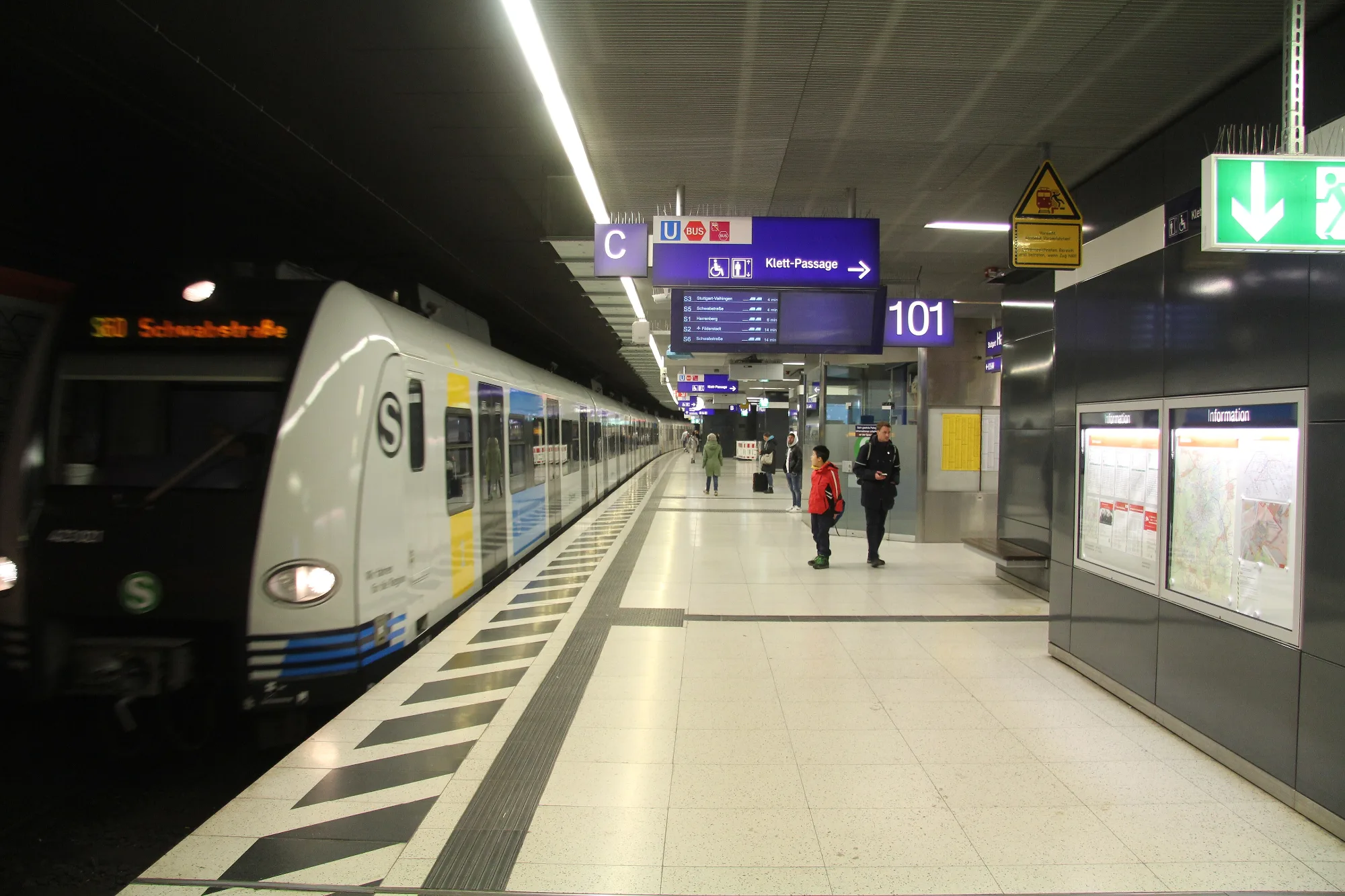
The tool was tested on the Stuttgart S-Bahn and has been in service since 2021, later extended to the Rhine-Main and Munich networks. In Stuttgart it can make up for delays of up to eight minutes. According to DB, the three networks together avoided 58,000 minutes of delay in one year. The company also estimates that, in theory, AI could allow 17 more trains a day in each direction on Stuttgart's core section, but this is an estimate, not a measured result.
This is how we are working, step by step, towards a nationwide real-time timetable.
Daniela Gerd tom Markotten, Deutsche Bahn board member for digitalisation and technology (2023)
The next step is harder. An S-Bahn is a relatively closed system with similar trains. That is why DB started testing the tool on the Elmshorn–Sylt line, which carries freight, regional and long-distance trains, and announced its extension to the Berlin and Hamburg S-Bahn. If the tests go well, the Mannheim–Basel corridor, one of the busiest in the country, comes next.
In parallel, research is trying to go beyond the order of passage and rebuild the whole timetable. In 2025, Digitale Schiene Deutschland presented a model in which each train is an "agent" that learns, over thousands of simulations, to coordinate with the others by adjusting speeds and stopping points. In a simulation of a real part of the network around Magdeburg, with up to 41 trains and unexpected disruptions, the model produced conflict-free timetables in 94% of scenarios, always in under 30 seconds. For 35 trains, classical methods need more than an hour. For now these are simulation results: there is no application in service, and the authors say they are still working on scale and decision quality.
Inspecting wagons without stopping them
Inspecting a freight train by hand is slow and, in many parts of the wagon, difficult: some components can barely be seen while the train is standing. In the United States, Norfolk Southern decided to turn the process around and inspect trains as they pass.
The inspection portals the company developed with the Georgia Tech Research Institute are trackside structures with 24-megapixel cameras, synchronised to the microsecond and lit like a stadium. Trains pass through at up to 70 mph (about 113 km/h), and each wagon produces on average about 1,000 images from every angle. The images are analysed by 38 deep learning algorithms. The results go to the network operations centre, and critical defects are flagged for immediate action.
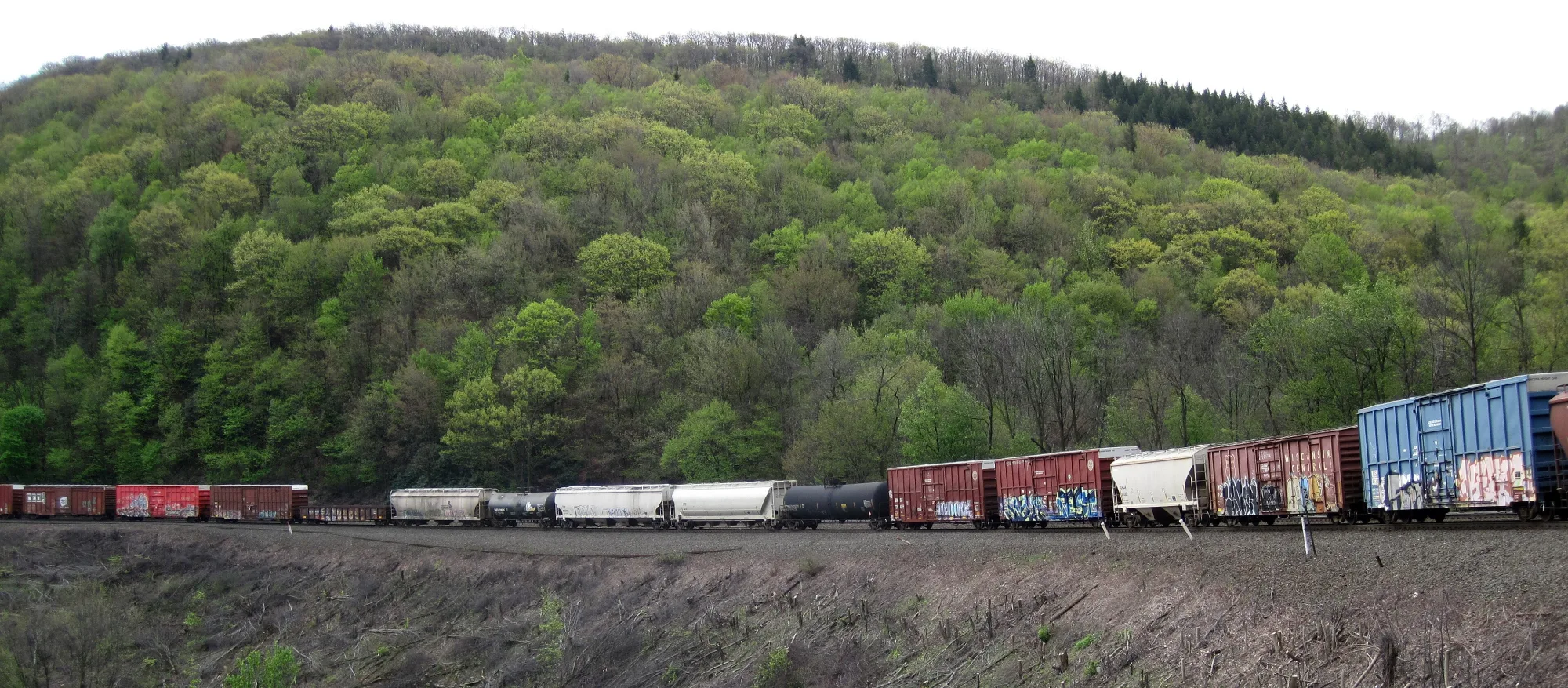
The first portal was installed in Leetonia, Ohio, at a point where a train passes every hour, and the company planned to have more than a dozen by the end of 2024. Norfolk Southern says the algorithms are highly accurate with few false alarms, but has not published figures. That is an important caveat: without detection and error rates, it is hard to compare with traditional inspection.
In Europe, DB applies the same idea to its passenger and freight trains. Trains pass under a camera bridge and image analysis identifies damage within minutes. Inspecting the roof of an ICE, which used to take several hours, now takes minutes. Instead of walking along the train looking for problems, maintenance teams receive a list of the vehicles that need attention. According to DB, time shifts from finding faults to fixing them.
Seeing beyond the braking distance
A train can only avoid a collision if it can stop before the obstacle, and that takes a lot of space. According to the European rules cited by the SMART2 project, a 2,000-tonne freight train at 80 km/h needs about 700 metres to stop. When the driver sees a car on a level crossing or a fallen tree, it is often too late. And most automatic obstacle detection systems in use only see up to about 80 metres.
The European SMART2 project, coordinated by the University of Bremen and completed in 2022, built on an earlier on-board system (with cameras and lidar) that already reached 1,000 metres. What was new was adding two more viewpoints: fixed sensors beside the track and a drone. All three send data to a cloud system that looks for hazards and supports decisions. Detection can then reach 2,000 metres and see past curves, slopes and tunnels, where the train's camera cannot.
The prototype was tested by Serbian Railways on a 5 km section with a bicycle on a level crossing and a fallen tree, both detected at well over two kilometres. The on-board system also travelled on an in-service freight train for 120 km between Niš and Ristovac, near the border with North Macedonia. The project has not published detection or false alarm rates, and it is not yet a product: the work continues under the Europe's Rail programme.
And the track?
The same logic is reaching infrastructure. We have already described how Network Rail inspects the track at 200 km/h: cameras photograph the rail every 0.8 mm and software flags possible defects for a team to check.
In Portugal, Infraestruturas de Portugal took part in the European IN2SMART and IN2SMART2 projects, funded by the Shift2Rail programme. The projects developed asset management tools that simulate how the condition of the track may evolve in the medium and long term and what effect each maintenance or investment decision would have. IP was responsible for development and validation in Portugal, with a pilot on the Linha do Norte. IP has not published results from the pilot.
Conclusions
The four cases have more in common than it seems. In none of them does AI replace the people who work on the railway: it helps them see more, further and faster, and leaves the decision to those who control traffic or carry out maintenance. But the cases are at very different stages, and it pays not to lump them together.
- AI recommends, people decide. At DB, the controller sees the recommendation and simulates its effect before deciding. At Norfolk Southern, flagged images go to the operations centre.
- The gains are in time. Minutes of delay avoided, inspections that go from hours to minutes, warnings that arrive hundreds of metres earlier. It sounds small, but on a busy network those minutes are what counts.
- No data, no AI. Every case starts with measurement: cameras, sensors, traffic records. The quality and continuity of those measurements matter as much as the algorithm.
- In service, in testing and in simulation are not the same thing. DB's tool has been in service since 2021, Norfolk Southern's portals are being rolled out, SMART2 is a prototype and the Magdeburg model exists only in simulation.
- The figures come from those who make the systems. Almost all the results were published by the operators and projects themselves, and independent data is missing, especially error and false alarm rates. That is what separates a good demonstration from a system that can be trusted every day.
Sources
- Deutsche Bahn, "Artificial intelligence at DB"
- CIO / dpa, "Bahn weitet KI-Projekt auf S-Bahnbetrieb in Hamburg und Berlin aus", 2023/06/19
- Digitale Schiene Deutschland, "Towards a Holistic Traffic Management System with Multi-Agent AI", 2025/03/18
- Railway News, "Norfolk Southern Launches Machine Vision Inspection Tech", 2023/10/30
- CORDIS, European Commission, "Improving autonomous object detection systems for trains", 2023
- Infraestruturas de Portugal, "Sabia que a IP está a desenvolver modelos preditivos para a manutenção da ferrovia?", 2023/06/30